
(2800–2700 BC)
For the first time, a name is carved in stone. A real king. A real war. Between 2800 and 2700 BC, history begins to remember itself. Enmebaragesi, king of Kish, leaves the first verifiable royal inscription. In Egypt, Khasekhemwy reunifies the kingdom after crisis. In the Indus Valley, urban sanitation and standardized weights lay the groundwork for great cities. And in South America, Caral builds pyramids without armies or walls — an alternative path to civilization. History stops being anonymous and starts becoming something we can tell.
⚡ Before watching, do you know the answer?
What makes Enmebaragesi, king of Kish, a turning point in history?
For the first time, a name is carved in stone. A real king. A real war. Between 2800 and 2700 BC, history takes a crucial step forward: it begins to remember itself. Conflicts are no longer isolated events. Rulers begin to leave their names behind. Cities compete for strategic resources, trade routes, and political prestige. Across different regions of the world, very different societies arrive at surprisingly complex — or radically different — solutions. This is no longer just where states are built. This is where history becomes something that can be told.
In southern Mesopotamia, the great Sumerian cities — Ur, Uruk, Lagash, and Kish — are now fully developed territorial states, with dense populations, complex irrigation systems, and bureaucracies capable of recording not just taxes, but conflict.
Here, a remarkable figure emerges: Enmebaragesi, king of Kish. Unlike many earlier rulers, Enmebaragesi is not confined to myth. His name appears in the Sumerian King List — and more importantly, it has been confirmed through archaeology. He is one of the first truly historical individuals whose power can be traced beyond symbolic narrative.
Kish goes to war with Elam, a region to the east (modern southwestern Iran). This is not a minor border clash. It is a conflict over strategic resources essential to the Bronze Age: access to Iranian tin and trade routes leading to lapis lazuli from Afghanistan. For the first time, war clearly becomes a geopolitical tool.
In Egypt, the period between 2800 and 2700 BC is not defined by monumental construction. It is quieter… but just as decisive. After the tensions and succession crises of the Second Dynasty, the Egyptian state seeks lasting stability.
The reign of Khasekhemwy marks the end of a turbulent phase. His name — "The Two Powers Have Appeared" — refers to the symbolic reunification of Upper and Lower Egypt after internal conflict. Under his rule, power is reorganized, administration strengthened, territorial control consolidated, and rituals standardized.
Monumental smooth-sided pyramids do not yet exist. But the political, economic, and religious foundations that will make them possible are being built. Egypt learns a crucial lesson: unification is not enough. Power needs rules, continuity, and legitimacy to survive over time.
Enjoying our content? Support us on Ko-fi

Your support helps us continue creating quality historical content
In the Indus Valley, this century is decisive — though quiet. Early Harappan communities begin to standardize their world. We see uniform mud-brick proportions, shared systems of weights and measures, and pottery produced according to repeated patterns.
The key innovation of this period is urban sanitation. From this early stage, homes include drainage systems, bathing areas, and wastewater disposal — a concern for public health that will not reappear in many regions for thousands of years.
We do not see great kings or monumental structures. But we do see a system that prioritizes collective organization. This century lays the groundwork for cities like Mohenjo-Daro and Harappa in their classical form. The Indus does not conquer. It prepares.
In the Supe River Valley, on the coast of present-day Peru, one of the most remarkable civilizations of the ancient world emerges: Caral. Its peak falls between 2800 and 2600 BC — fully contemporary with Mesopotamia and Egypt. But completely isolated.
Caral has no writing, no bronze, and no organized warfare. And yet, it builds a complex and enduring society: sunken circular plazas, large ceremonial platforms, U-shaped temples, and neighborhoods differentiated by social status.
There are no walls. No armies. Power appears to rest on religious, economic, and symbolic control. Caral proves that civilization does not necessarily require war to organize itself. It is an alternative model — and a deeply unsettling one for our traditional assumptions.
In the Cycladic islands, specialized workshops produce stylized marble idols. These are not isolated objects. They circulate across the Aegean, becoming one of the first shared artistic languages in the region. In southern Iberia, the Los Millares culture builds a fortified settlement with concentric walls, ditches, and an extensive necropolis.

c. 2750 BC • Stone vessel • Mesopotamia
One of the earliest verifiable royal inscriptions. History's fog begins to lift.
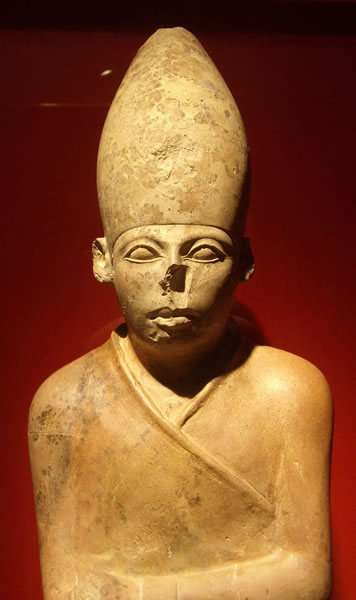
c. 2700 BC • Schist • Hierakonpolis, Egypt
Depicts the pharaoh who reunited Egypt after the Second Dynasty crisis.

c. 2700 BC • Marble • Cyclades, Aegean Sea
A shared artistic language spreading across the Mediterranean.

c. 2700 BC • Stone • Supe Valley, Peru
Built without metal tools, writing, or organized warfare. An alternative civilization.
Enjoying our content? Support us on Ko-fi
Your support helps us continue creating quality historical content
Mesopotamia: Enmebaragesi rules Kish. First verifiable royal inscriptions appear. War with Elam over trade routes.
Egypt: Khasekhemwy reunifies Egypt after the Second Dynasty crisis. His name celebrates "The Two Powers."
Indus Valley: Standardization of bricks, weights, and urban sanitation systems begins.
South America: Caral reaches its peak — pyramids without armies or walls. Cyclades: Marble idols circulate across the Aegean.
Enjoying our content? Support us on Ko-fi
Your support helps us continue creating quality historical content
The appearance of Enmebaragesi's name in the archaeological record is not just a curiosity. It marks a threshold. For millennia, rulers existed in oral tradition, lost to us behind the fog of prehistory. But around 2800 BC, someone decided that a name should be carved into stone. That decision changes everything.
History is no longer anonymous. It becomes personal. And with that comes a new dimension of power: legacy. Rulers are no longer just administering resources or winning battles. They are ensuring that their name will be remembered. This is the beginning of political memory — the awareness that power must be recorded to survive.
Enjoying our content? Support us on Ko-fi
Your support helps us continue creating quality historical content
Kish's war with Elam is not about honor or revenge. It is about control over strategic resources. Tin — essential for making bronze — came from the Iranian plateau. Lapis lazuli — the most prestigious gemstone in Mesopotamia — came from distant Afghanistan. Whoever controlled the trade routes controlled power itself.
This century marks the birth of geopolitical thinking. War is no longer a seasonal necessity. It is a calculated tool for securing distant resources. The Bronze Age economy, intercontinental and fragile, is now a theater of conflict.
Caral is not a marginal footnote in ancient history. It is a standing refutation of the assumption that civilization requires war. Here we have monumental architecture, social hierarchy, economic specialization, and cultural sophistication — all without weapons, walls, or royal tombs.
The lesson from Caral is radical: there is no single path to civilization. Some societies build through competition. Others through cooperation. And some, like Caral, through ritual and economic coordination. The ancient world is not a ladder leading upward. It is a garden with many branches.
Answer these three questions about 2800-2700 BC:
1️⃣ What makes Enmebaragesi, king of Kish, historically significant?
2️⃣ What was the key innovation of the Indus Valley during this period?
3️⃣ What makes Caral (Peru) unique among ancient civilizations?
 Subscribe