
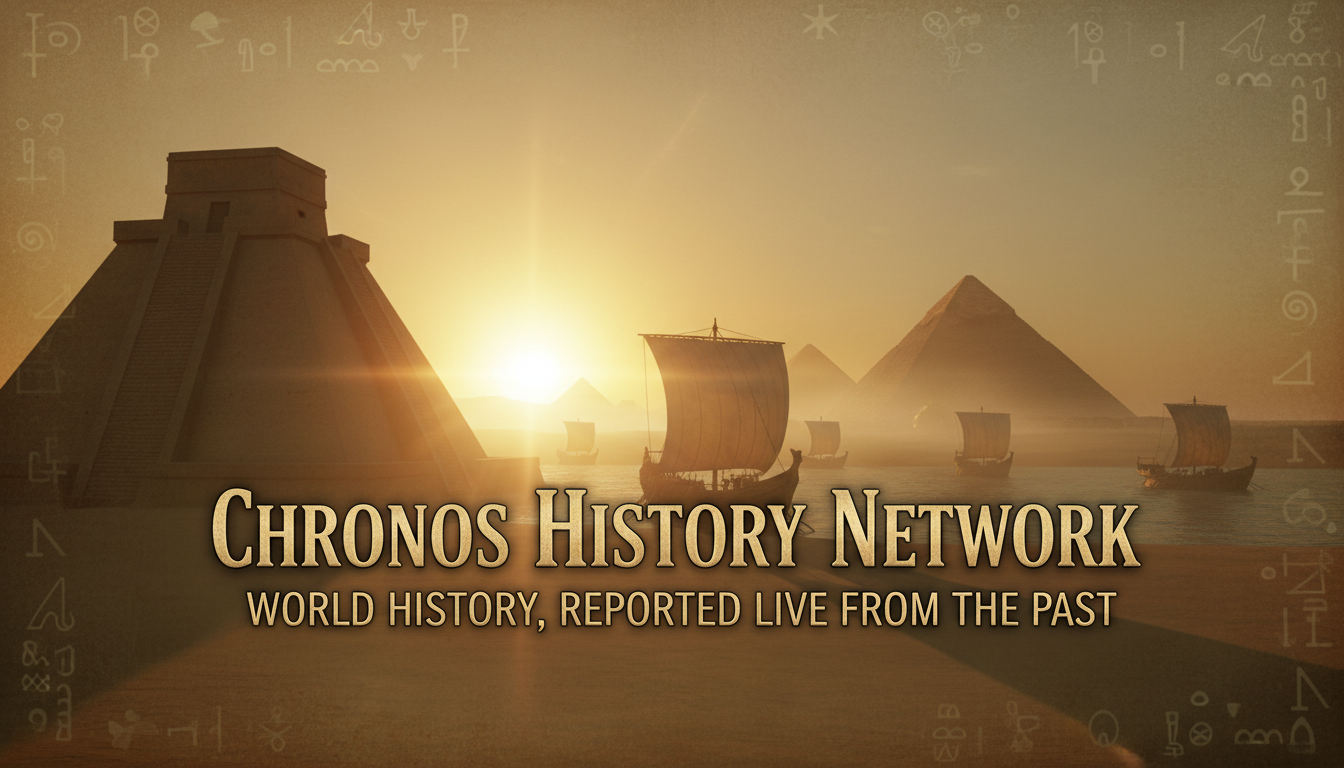
Uruk, Nile & Indus (3500 BC)
Tonight, humanity crosses a threshold. The first true cities are rising… and the first written symbols are beginning to appear. In Uruk, the first great city of history surpasses 10,000 inhabitants. The White Temple dominates the landscape as a religious, economic, and administrative center. Scribes use clay tablets to record goods and transactions, laying the foundations of writing. In the Nile Valley, the Naqada culture develops ceremonial constructions and grain storage, while emerging elites use symbols of authority. In the Indus Valley, settlements show surprising urban planning with aligned streets and drainage systems. This is where it all begins.
⚡ Before watching, do you know the answer?
What structure dominated Uruk as a religious, economic, and administrative center?
In 3500 BC, the world was undergoing fundamental transformations. The first complex societies were beginning to evolve into genuine civilizations, with growing urban centers, emerging record-keeping systems, and new forms of political organization. On this page you'll find supplementary information to the episode, including discovered artifacts, detailed analysis, and maps illustrating how these first cities laid the foundations of civilization.
In Mesopotamia, Uruk was becoming the most important urban center in the world. With a population exceeding 10,000 inhabitants, the city experienced unprecedented growth driven by administrative and architectural innovations.
Enjoying our content? Support us on Ko-fi

Your support helps us continue creating quality historical content
In the Nile Valley, local chiefdoms were experiencing an unprecedented process of power concentration. Communities of the Naqada culture were developing more complex ceremonial constructions and storage systems.
In the Indus Valley, settlements showed surprising planning characteristics. Rectangular dwellings with sun-dried bricks were organized along aligned streets with primitive drainage systems.
In Uruk, administrators began using clay tablets with signs representing quantities, products, and recipients. These systems laid the groundwork for the development of cuneiform writing.
The White Temple of Uruk represented an unprecedented architectural advance, requiring large-scale coordination and considerable resources.
The development of irrigation systems was fundamental for increasing agricultural production and sustaining larger populations.
The horse was beginning to be domesticated in the northern steppes, while maritime routes in the Aegean enabled regular exchange.
Enjoying our content? Support us on Ko-fi
Your support helps us continue creating quality historical content
Although these civilizations had no direct contact with each other, there were trade routes connecting distant regions. The trade of obsidian, precious metals, and raw materials facilitated the exchange of ideas and technologies.
Despite the distances, these societies shared similar patterns: urban growth, labor specialization, development of record-keeping systems, and concentration of power in the hands of emerging elites.
Enjoying our content? Support us on Ko-fi
Your support helps us continue creating quality historical content
Writing essentially emerges as a response to an administrative need. When a community grows and accumulates goods, it becomes necessary to record them to avoid conflicts, maintain inventories, and plan distribution. In Uruk, experiments were being made with clay tablets showing signs that represented quantities, products, and recipients.
This advance enabled coordination of work such as temple construction, irrigation systems, or canals, as well as strengthening the authority of those who controlled these records.
First symbols carved on bone and stone in various regions of the world.
Clay seals and tokens in the Near East for recording agricultural goods.
First record-keeping systems on clay tablets in Uruk.
Emergence of cuneiform writing in Mesopotamia and hieroglyphic writing in Egypt.
Enjoying our content? Support us on Ko-fi
Your support helps us continue creating quality historical content
In the northern steppes, communities were experiencing advances in horse domestication. Although not yet used for riding, it already played a crucial role in transporting light chariots.
On the Yellow River, villages associated with the Longshan culture were producing polished black ceramics with increasingly sophisticated forms.
Several Aegean islands showed signs of maritime routes enabling regular exchange of obsidian, pottery, and food among small coastal communities.
Enjoying our content? Support us on Ko-fi
Your support helps us continue creating quality historical content
Answer these three questions about 3500 BC:
1️⃣ What material did administrators in Uruk use to record goods and transactions?
2️⃣ What characteristic distinguished the Indus Valley settlements in 3500 BC?
3️⃣ What did the Naqada culture in Egypt develop during this period?
 Subscribe