The Birth of the Pharaoh: How Warlords Unified Egypt
The Nile Valley was burning. Not from the sun, but from war. For decades, the warlords of Upper Egypt had been tearing each other apart. Whole cities razed. Enemies brought to their knees. But then, one of them understood something no one had understood before: power isn't proven with a mace. Power is written. And if you write your name big enough, the whole world will fear you.
⚡ Before you read, do you know the answer?
Which predynastic king is known for his serekh, the first heraldic emblem of Egyptian kingship?
The Nile Valley was burning. Not from the sun, but from war. For decades, the warlords of Upper Egypt had been tearing each other apart. Whole cities razed. Enemies brought to their knees. But then, one of them understood something no one had understood before: power isn't proven with a mace. Power is written. And if you write your name big enough, the whole world will fear you.
Between 3200 and 3100 BC, in the Nile Valley, there was no Egypt. There was a dozen small kingdoms that hated and killed each other. Hierakonpolis, Naqada, Abydos, and Buto. Each with its own king, its own army, its own ambition. But this century's change wasn't just another war. It was the birth of an idea: the idea that a single man could rule the entire valley. And that idea was the work of three kings we barely know, but who changed the world forever.
The Scorpion King: the first hint of pharaonic power
The first was the Scorpion King. A ruler who carried the name of a venomous animal, with the falcon of Horus carved beside him. On the Scorpion Macehead, found at Hierakonpolis, he appears wearing the White Crown of Upper Egypt, taking part in an irrigation ceremony. We don't know if he unified Egypt. But his image, next to a scorpion and a falcon, is already the first hint of pharaonic power.
King Ka: the birth of the serekh
The second was King Ka. His name, inscribed inside the earliest known serekh, already carried the heraldic emblem of kingship. It was no longer just a name — it was a sacred symbol. Ka is one of the best-attested predynastic kings, with inscriptions found not only at Abydos, but also at Adaima, Tarkhan, Helwan, and even in the southern Levant. This suggests his influence reached beyond Upper Egypt, perhaps as part of an expansion north and east.
Narmer: the unifier
The third was Narmer. The most famous of them all. The one who, according to tradition, unified Upper and Lower Egypt in a single military campaign. But the reality was more complicated. Because unification wasn't one single battle. It was a decades-long war, with razed cities, humiliated enemies, and broken alliances. Along the banks of the Nile, the armies of the south clashed with the forces of the delta. Archers fired from the shore. Boatmen fought on the water. And in the middle of the chaos, the southern kings kept gaining ground, city by city, fortress by fortress.
But war wasn't everything. There was another battlefield: trade. The rulers of the south controlled the routes that brought copper from Sinai, gold from Nubia, and timber from Lebanon. That flow of wealth let them pay armies, buy loyalty, and build the first monumental tombs, the mastabas. War and trade went hand in hand, feeding a cycle of power never seen before in the valley.

The Narmer Palette (c. 3100 BC). On this side, the king appears wearing the White Crown of Upper Egypt, ready to strike down his enemy. It's the first time the image of a king striking down his enemies becomes an official symbol of power. Egyptian Museum, Cairo. Source: Wikimedia Commons.
The Narmer Palette: the first work of political propaganda
And in the middle of that war and that trade, the first great work of political propaganda in history was born: the Narmer Palette. On this siltstone palette, sixty-four centimeters tall, Narmer appears wearing the White Crown of Upper Egypt on one side and the Red Crown of Lower Egypt on the other. In it, he grips an enemy by the hair, ready to strike him down with his mace. It's the first time the image of a king striking down his enemies becomes an official symbol of power. An image that would repeat for the next three thousand years.
But the palette didn't show only violence. It also showed hieroglyphs. Because it was in this century, in the context of unification, that the first true hieroglyphic writing appeared. Not on papyrus, but on ivory labels and pottery vessels found at Abydos. They were used to record taxes and the king's name. They were the first step of a communication system that would be used for centuries to come.
The legacy of unification
And while Narmer and his predecessors were consolidating power in the valley, something else was happening beyond it. The century before, trading posts and mudbrick fortresses had already been set up in the lands of Canaan, which would serve as a springboard to compete with the cities of Mesopotamia.
The unification of Upper and Lower Egypt under Narmer marked the start of the Dynastic Period, the age of the pharaohs. But it wasn't a peaceful moment. It was the birth of a war-and-administration machine that would dominate the ancient world for three thousand years. The serekh, that rectangle holding the king's name, became the seal of royalty. The image of the pharaoh striking down his enemies became the symbol of order and justice. Hieroglyphs, which began as simple administrative marks, became the language of the gods. And the figure of the pharaoh, the divine king ruling by the mandate of Horus, became the idea that would sustain Egyptian civilization for the next three thousand years.
💭 My personal reflection
What fascinates me most about this period is how power turns into symbol. The Scorpion King, King Ka, and Narmer didn't just conquer territory. They invented a visual language to represent power. The serekh, the palette, the image of the king striking down his enemies... all of it is political propaganda, yes. But it's also art, religion, and writing at the same time.
When we look at the Narmer Palette, we aren't just seeing a historical record. We're seeing the birth of an idea: the idea that power can be represented, written, and passed down through the centuries. And that idea — that power is written — is what allowed Egypt to become a three-thousand-year civilization.
History isn't always written by the victors. Sometimes it's written by those who knew how to represent their power.
The world of the predynastic kings (3200-3101 BC)
Hierakonpolis — The capital of the south
Hierakonpolis (Nekhen in Egyptian) was one of the most important cities of Upper Egypt during the predynastic period. It was the center of the cult of the falcon god Horus, and its rulers were the first to adopt the falcon as a symbol of their power. Here were found the Scorpion Macehead and the Narmer Palette, two of the most important objects for understanding the birth of pharaonic power.
Archaeologists have documented a large ceremonial complex at Hierakonpolis, with a temple dedicated to Horus dating from this time. The city was the political and religious center of the kings who would unify Egypt.
Abydos — The royal necropolis
Abydos was the burial place of the predynastic kings and the first dynasties. Here lie the tombs of Iry-Hor, Ka, and Narmer, excavated in the cemetery of Umm el-Qa'ab. Ka's tombs (B7 and B9) contain more than forty inscriptions on pottery vessels and stone cylinders, showing the king's importance and his ability to mobilize resources.
Abydos wasn't just a necropolis: it was the center of the cult of Osiris, the god of the dead, and its religious importance lasted throughout Egyptian history.
Naqada — The heart of predynastic power
Naqada was one of the most important political centers of Upper Egypt during the Naqada III period (c. 3200-3000 BC). Its name gave its name to an entire culture: the Naqada culture, which preceded the unification of Egypt. The rulers of Naqada controlled the trade routes linking the Nile Valley with the Red Sea and Nubia.
At Naqada, rich tombs have been found with luxury objects such as stone vessels, siltstone palettes, and jewelry of gold and lapis lazuli. It was an elite that accumulated wealth and power, competing with those of Hierakonpolis and Abydos.
Buto — The capital of Lower Egypt
In the Nile Delta, Buto was the center of Lower Egyptian power. It was the city of the cobra goddess Wadjet, and its symbol was the Red Crown that Narmer would adopt after unification. Buto was the main rival of Upper Egypt for decades, until the forces of the south finally conquered it.
Map of the predynastic kingdoms of Egypt (3200-3101 BC)
Main cities and necropolises of the late predynastic period. Source: archaeological data.
Key artifacts of the period (3200-3101 BC)
Narmer Palette (reverse face)
c. 3100 BC • Siltstone • Hierakonpolis, Egypt
Narmer appears wearing the White Crown of Upper Egypt, ready to strike down his enemy. The first great work of political propaganda in history.
📷 Egyptian Museum, Cairo / Wikimedia Commons

Narmer Palette (obverse face)
c. 3100 BC • Siltstone • Hierakonpolis, Egypt
Narmer appears wearing the Red Crown of Lower Egypt, inspecting decapitated enemies. The unification of Upper and Lower Egypt in a single image.
📷 Egyptian Museum, Cairo / Wikimedia Commons

Scorpion Macehead
c. 3200 BC • Limestone • Hierakonpolis, Egypt
The Scorpion King appears wearing the White Crown of Upper Egypt, taking part in an irrigation ceremony. It's the first hint of pharaonic power.
📷 Ashmolean Museum / Wikimedia Commons
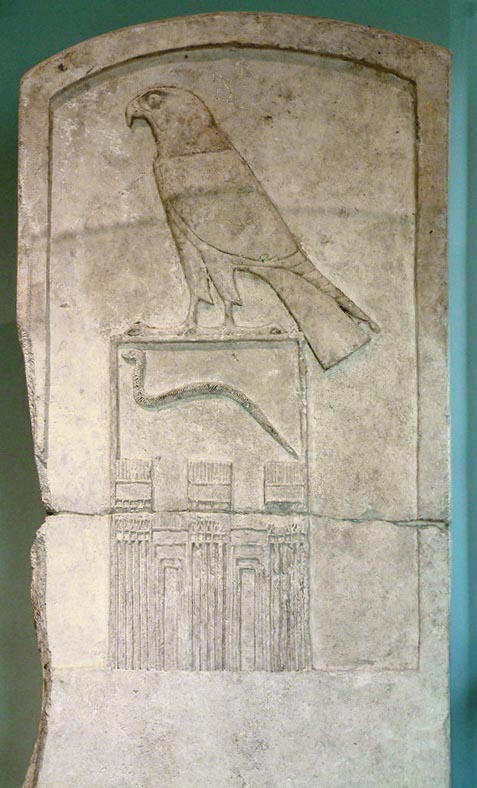
Serekh of King Ka
c. 3150 BC • Clay • Abydos, Egypt
The earliest known serekh in Egyptian history. King Ka's name appears inside a rectangle crowned by the falcon of Horus.
📷 Louvre Museum / Wikimedia Commons
Timeline (3200-3101 BC)
c. 3200 BC
Egypt: The Scorpion King rules at Hierakonpolis. His Macehead shows him wearing the White Crown of Upper Egypt, taking part in irrigation ceremonies.
c. 3150 BC
Egypt: King Ka, possible successor of Iry-Hor, introduces the serekh, the rectangle containing the king's name and the falcon of Horus.
c. 3130 BC
Egypt: Ka extends his influence beyond Abydos, with inscriptions found at Tarkhan, Helwan, and in the southern Levant.
c. 3100 BC
Egypt: Narmer unifies Upper and Lower Egypt after decades of war. The Narmer Palette commemorates the victory and establishes the image of the pharaoh striking down his enemies.
c. 3100 BC
Egypt: The first hieroglyphs appear on ivory labels and pottery vessels at Abydos. Writing is born as a tool for recording and propaganda of royal power.
Biographies of authors and archaeologists
The study of the Egyptian predynastic period rests on decades of work by archaeologists and historians who have excavated and analyzed the evidence from this crucial moment.
Günter Dreyer
German archaeologist, known for his excavations at the cemetery of Umm el-Qa'ab at Abydos. His work has been fundamental for identifying and ordering the predynastic kings, including Iry-Hor, Ka, and Narmer.
Key contribution: Excavations at Abydos that established the chronological sequence of the Dynasty 0 kings.
Toby Wilkinson
British Egyptologist, specialist in the predynastic period and the first dynasties. He is known for his work on the unification of Egypt and the development of the pharaonic state.
Main work: Early Dynastic Egypt (1999) and The Rise and Fall of Ancient Egypt (2010).
Flinders Petrie
British archaeologist, pioneer in the excavation of predynastic and early dynastic sites in Egypt. He excavated at Abydos, Naqada, and Hierakonpolis, and was the first to identify the Narmer Palette.
Key contribution: Excavations at Abydos (1902) that uncovered the tombs of Ka and other predynastic kings.
Barbara Adams
British archaeologist specializing in the Egyptian predynastic period. She worked extensively at Hierakonpolis and authored important studies on the Narmer Palette and the Naqada Culture.
Main work: Ancient Nekhen: Garstang in the City of Hierakonpolis (1995).
In-depth historical analysis
Why did the southern kings unify Egypt?
Egypt's unification wasn't a single event, but a decades-long process driven by economic, political, and religious factors. Upper Egypt was richer than Lower Egypt: it controlled the trade routes to Nubia (gold, ivory, ebony) and Sinai (copper, turquoise). That wealth allowed the southern kings to fund armies and build alliances.
But there was also an ideological factor. The kings of Hierakonpolis presented themselves as the representatives of Horus, the falcon god, and their victory over Lower Egypt was interpreted as a triumph of divine order over chaos. The Narmer Palette is not just a historical record: it's a theological manifesto justifying unification by divine mandate.
The serekh: the invention of royal identity
The serekh is one of the most important innovations of this period. It was a rectangle containing the king's name, topped by the falcon of Horus. It wasn't just a name: it was a sacred emblem identifying the king as the incarnation of Horus on earth.
The earliest known serekh belongs to King Ka, who ruled in the mid-32nd century BC. Its invention marks the moment when royal power becomes a visual symbol that can be reproduced, displayed, and recognized. The serekh remained the seal of kingship for the next three thousand years, until the Roman era.
Writing as a tool of power
Hieroglyphic writing wasn't born as literature or poetry. It was born as a recording tool for royal administration. The first hieroglyphic inscriptions, found at Abydos, are ivory labels and pottery vessels recording the king's name and taxes.
But writing also had a propaganda function. The Narmer Palette contains hieroglyphs identifying the king, his enemies, and the conquered cities. Writing the king's name on an object wasn't just an administrative act: it was an act of power. The king's name, written in hieroglyphs, became a sacred symbol that lasted forever.
📜 Test your knowledge
Answer these three questions about the period 3200-3101 BC in Egypt:
1️⃣ Which predynastic king is known for his serekh, the first heraldic emblem of Egyptian kingship?
2️⃣ Which object commemorates Narmer's unification of Upper and Lower Egypt?
3️⃣ Which Upper Egyptian city was the center of the Horus cult and the site of the Narmer Palette discovery?
📺 Want to watch the full episode?
This chronicle is part of our century-by-century journey through Ancient History. In the full episode of the 4th millennium BC, we explore how Egypt, Mesopotamia, the Indus, and other regions laid the foundations of the first civilizations.
🗺️ Watch full episode 🔔 Subscribe to CHN📚 Sources and references
- Wilkinson, Toby. Early Dynastic Egypt. Routledge, 1999.
- Wilkinson, Toby. The Rise and Fall of Ancient Egypt. Random House, 2010.
- Dreyer, Günter. "Umm el-Qaab I: Das prädynastische Königsgrab U-j." Archäologische Veröffentlichungen 1998.
- Adams, Barbara. Ancient Nekhen: Garstang in the City of Hierakonpolis. Egyptian Studies Association, 1995.
- Van De Mieroop, Marc. A History of the Ancient Near East, ca. 3000-323 BC. Wiley-Blackwell, 2015.
- Petrie, Flinders. The Royal Tombs of the First Dynasty. 1900-1901.
📖 Further reading
Here are some topic ideas and resources you can explore to go deeper into this period. We recommend searching for the best articles, videos, and academic publications in English on:
- The meaning and evolution of the serekh in Egyptian kingship
- The iconography of the Narmer Palette and its importance as political propaganda
- The role of Hierakonpolis as the political and religious center of Upper Egypt
- The royal tombs of Abydos and what they reveal about the first pharaohs
- The transition from the predynastic period to the Dynastic Period in Egypt
- The emergence of hieroglyphic writing and its relationship with royal power
 Subscribe